
ongoing research
Queering Home: Using Photovoice to Explore 2SLGBTQ+ Adults’ Shared Housing Models and Practices
Queering Home examines shared housing models and practices among 2SLGBTQ+ adults in Ontario and Alberta who have chosen intentional and long-term cohabitation with others with whom they are not legally related or romantically involved (e.g., friends). It uses photovoice methods, a participatory action research method that combines photography and group discussion.
The study asks: (1) Why do 2SLGBTQ+ adults enter into long-term shared housing arrangements with others to whom they are not legally related or romantically involved, and what meaning do they make from their cohabitation situations and practices?; and (2) How do intersections of age, ability, race, migration experience, socio-economic status, and housing policy context shape the formation and practices of such households? Through this study, we aim to learn more about the social and economic drivers and impacts of shared housing, and build critical knowledge relating to the intersection of housing and 2SLGBTQ+ identities and social relations.
This research is funded by a SSHRC Insight Development Grant, and is a collaboration with Dr. Victor Perez-Amado, Dr. Gloria Pérez-Rivera, and Dr. Brittany A. E. Jakubiec. It builds on a multi-year collaboration with Dr. Victor Perez-Amado in which we worked with three consecutive urban planning graduate classes students to explore 2SLGBTQIA+ shared housing in Vancouver, Calgary, Toronto, and Charlottetown; and LGBTQ+ newcomer shared housing research
TransAthletics: Examining Community and Institutional Impacts of Anti-Trans Ideologies on Sport in Alberta
This qualitative research focuses on the impact of anti-trans ideologies and policies, including The Fairness and Safety in Sport Act, on trans and nonbinary athletes and on relevant institutions and athletic organizations operating in Alberta. The data collected will be used to: (a) to critically examine and situate contemporary discourse on trans athletes in a broader historical and transnational frame and (b) to inform policy and practice recommendations. It is a collaboration with Gio Dolcecore, Eva Bošnjak, and Marty Clark.
Stranger Than Family: Decision-Making and Ethics of Substitution for People Living with Dementia Going it Alone
This research focuses on how ideas of capacity, consent, and decision-making affect people facing dementia who are “going it alone” and the people who are not close friends or family members who become involved in representing them as substitute decision-makers.
The goals of this study are: (a) To better understand how people who are facing dementia alone find or are connected with substitute decision-makers who are not close family members or close friends; (b) To better understand how social ideas about “consent”, “capacity”, and “decision-making” shape substitute decision-making frameworks, and how substitute decision-makers act in their roles; and (c) To identify opportunities for advocacy, policy, and practice change to better support people facing dementia alone and others involved in supporting and advocating for them. This research is funded by the Alzheimer Society Research Program.
Underdiagnosed and Underserved: Examining Socio-Linguistic Barriers to Dementia Diagnosis and Services
This exploratory qualitative study examines the availability and accessibility of dementia diagnosis tools and services for those facing socio-linguistic barriers in Alberta. To better understand the barriers to dementia diagnosis and adequate care faced by those with socio-linguistic barriers (e.g., racially minoritized, non-English speakers), we are interviewing geriatricians, doctors, and service providers and analyzing cognitive testing tools. Led by Dr. Irene Shankar, this research is funded by a SSHRC Explore Grant.
QriTical: queer + trans research hub
The QriTical: queer + trans research hub serves as a connector and intellectual hub for 2SLGBTQIA+ faculty, students, and the broader community at Mount Royal University. The Hub is a space for researchers, teachers, students, and community members to engage with research, pedagogies, and social change mobilizations that challenge cisgender and heterosexual norms from an intersectional lens. We are committed to decolonial, anti-racist, anti-oppressive engagements with queer and trans studies, broadly defined.
past research
Reorienting Response: An Ethnography of Old Age, Disability, and Queer Lives in Canada
This PhD research examined the social dynamics and norms shaping the lives and care experiences among LGBTQ older adults living in long-term care homes and non-institutional setting in Toronto, Canada.
Based on 16 months of multi-sited ethnographic fieldwork, and upwards of 100 interviews with LGBTQ older adults, care workers, community advocates, attorneys for care, and others, Reorienting Response examined a critical nexus of queer and trans aging, disability, and “care”. It explored key issues of consent & capacity; senility, dementia, and gender nonconformity; voice and articulation; proximity and queer desire in institutional care; and death and dying. This research was supported by a Social Science and Humanities Research Council (SSHRC) Doctoral Award, the Ontario Graduate Scholarship, and other financial support from the Bonham Centre, Institute for Life Course & Aging, and the Department of Anthropology at the University of Toronto.
First-in-Family at Mount Royal University: An Arts-Based Action Scholarship of Teaching and Learning Project
First-in-Family was an arts-based action scholarship of teaching and learning project that engaged a group of Mount Royal University undergraduate students who are the “first-in-family” (or “first generation”) to pursue post-secondary education in a 7-session arts & dialogue program in Fall 2024.
This research asked: “What are the challenges that Mount Royal University undergraduate students who are the “first-in-family” face and what tools and supports do they, or could they, draw upon to counter these challenges? How can arts-based engagement impact the experiences of students who are “first-in-family”, and amplify their visions of accessible postsecondary education? The study was funded by an MRU Mokakiiks Scholarship of Teaching and Learning Collaborate Grant. It was led by PI Dr. Gloria Pérez-Rivera in collaboration with social artist Melanie Schambach, Co-Investigator Gio Dolcecore, and Student Co-Creator participants. The image below was created by Melanie Schambach with narratives and images shared by Student Co-Creator participants and illustrates these students’ reflections on first-in-family experiences and hopes for futures of more accessible university education.

Exploring Gender Euphoria through Arts-Based Action Research with Youth & Their Caregivers
This arts-based action research project examined how Calgary-based trans and gender creative (TGC) youth and their caregivers define and experience “gender euphoria” in local social contexts (e.g., educational settings, healthcare, sports and recreation), through arts-based focus groups. A collaboration with researchers Leah Hamilton, Corinne Mason, Gio Dolcecore, and Jill Thompson, and social artists Katie Green and Melanie Schambach, it was funded by a SSHRC Explore Grant.
Aging with Affirmation: A Study to Examine the Social Service Experiences and Needs of Older Transgender and Gender Diverse Adults in Canada
This study focused on how older transgender (trans) and gender diverse (TGD) experience social services in Canada, and what can be done to strengthen social services intended for their use. The project was led Hannah Kia, an Assistant Professor at the University of British Columbia’s School of Social Work, in partnership with Egale Canada.
Aging and Living Well Among LGBTQI Older Adults in Canada
In this study, our research team interviewed 48 LGBTQI older adults across Canada about their experiences of aging and perspectives on “living well”. The first research report highlights key findings related to employment; housing; social connection and disconnection; healthcare access; and death and end-of-life wellbeing. Free narrative-based educational modules are available in English and French here.
Action Through Connection: Promoting LBQ Health in Canada
Action Through Connection aimed to learn more about the healthcare access experiences of women, trans, and nonbinary people who are lesbian, bi+, and/or queer in Canada, and to identify priorities for intersectoral action. Our research report shares findings under six domains: labour in accessing care; accessing primary care; sexual and reproductive healthcare; gender-affirming and transition-related healthcare for trans and nonbinary people; mental healthcare; and complementary & alternative medicine and mutual aid. Our article in Social Science & Medicine examines the impact of racism & cisheterosexism on care access.
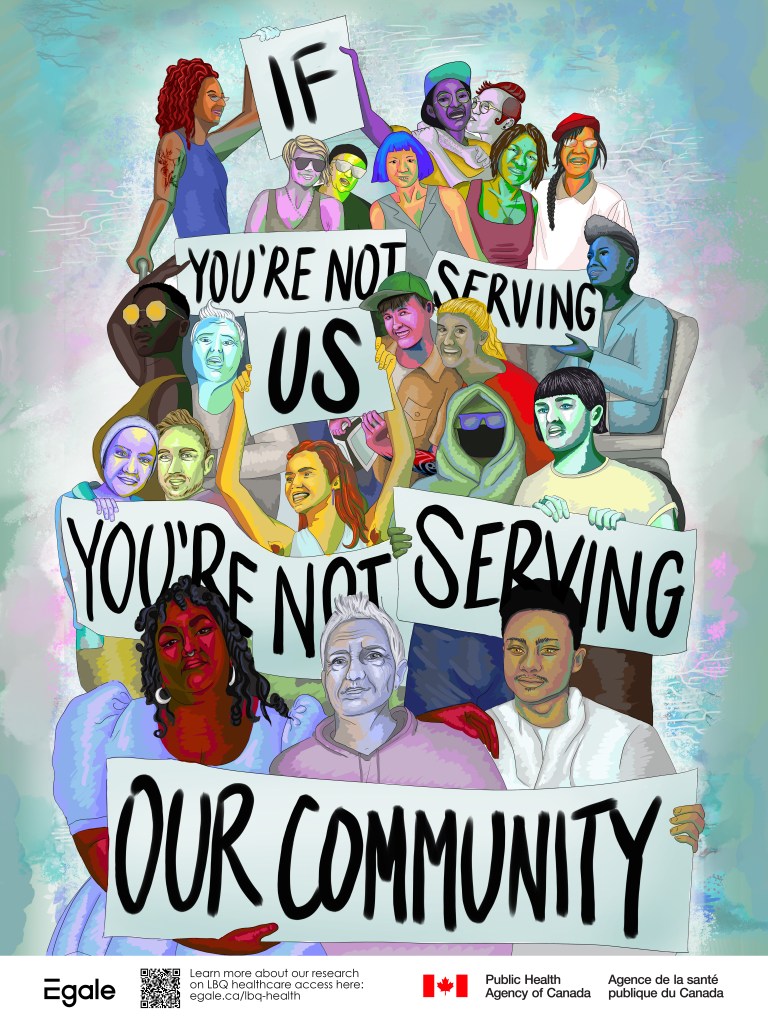
We worked with social artist Melanie Schambach to produce three posters inspired by participants’ perspectives and experience of healthcare (including the image above). These can be downloaded for free for display in healthcare setting, community centers, and other relevant locations. This work was funded by the Public Health Agency of Canada.
Fostering Dialogues: An Arts-Based Action Research Project Imagining Futures of Community-based Care with Homecare Personal Support Workers and LGBTQ Older Adults
Fostering Dialogues was an arts-based action research project that brought together LGBTQ older adults and personal support homecare workers from Ontario in a virtual 12-week arts & dialogue program. This program explored themes of home, care, and futures of community-based care through facilitated conversations, art-making, and co-creation of a digital mural. This research was funded by a CIHR Catalyst Grant and was a collaboration between Egale Canada and social artist Melanie Schambach.
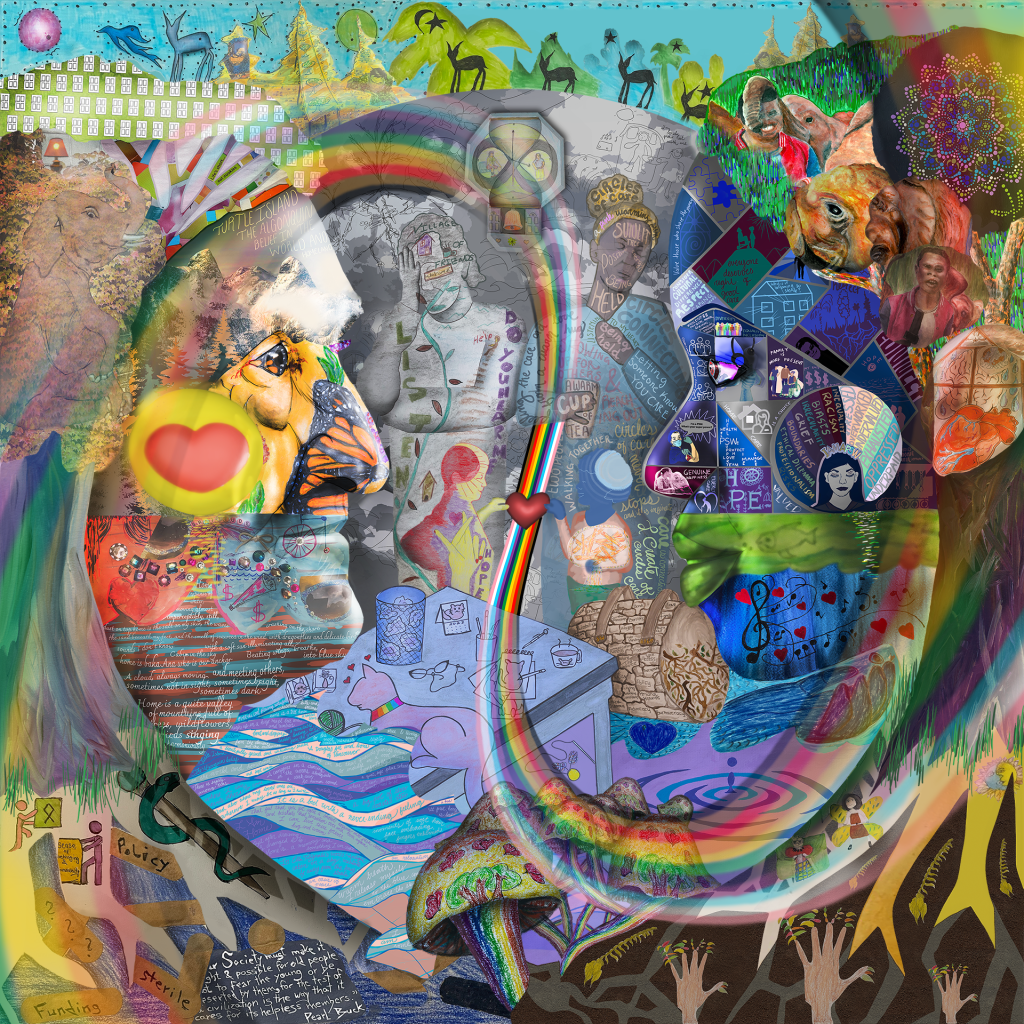
We produced a research report and interactive exhibit showcasing participants’ contributions and the digital mural (above), “Imagining futures of care”, that they co-created.
Coming Out and Coming in to Living with Dementia: Enhancing Support for 2SLGBTQI People Living with Dementia and Their Primary Unpaid Carers
In my role as a researcher at Egale Canada, I co-led a national study focused on dementia and unpaid caring among 2SLGBTQI people in Canada. For this research, conducted in collaboration with the National Institute on Ageing, we held focus groups and interviews with 2SLGBTQI people living with dementia and their primary unpaid carers (including friends, family members, and community members) from across the country. The final report highlights key findings and recommendations from this research. These findings informed the creation of a set of open-access educational modules geared towards healthcare and social service providers and the general public. Listen to a presentation about the research here.
The National Resource Centre on 2SLGBTQI Aging
A collaboration between Egale Canada and the National Institute on Ageing, The National Resource Centre on 2SLGBTQI Aging is a resource centre focused on the lived experiences of 2SLGBTQI older adults and aging issues in Canada. The site is a storehouse of information, research and resources for 2SLGBTQI older adults, their communities, and for those who provide social service and care to these groups.
© Copyright 2026 Celeste Pang
 Celeste Pang